| Author |
 Topic Search Topic Search  Topic Options Topic Options
|
theropod 
Orange Level


Joined: 28 Sep 2017
Location: Arkansas USA
Points: 217
|
 Post Options Post Options
 Thanks(0) Thanks(0)
 Quote Quote  Reply Reply
 Topic: Lead Used Old Allis Paint? Topic: Lead Used Old Allis Paint?
Posted: 31 Oct 2017 at 2:54pm |
|
i have begun the elctrolysis on the fenders from my old 38 B. I chopped the top off a plastic 55 gallon drum and made a deep tank for the larger parts. The first fender has been boiling away for 3 days and what was left of the old paint is beginning to come off in slabs. I take that as a sign I am about done with fender #1. My question is did Allis Chalmers use paint with lead in it? My sacrifical iron keeps collecting this bluish depsoit the gas tank didn’t produce, and I am wondering if that is lead from the paint.
|
 |
|
Sponsored Links
|
|
|
DougS
Orange Level

Joined: 03 Nov 2011
Location: Iowa
Points: 2490
|
Post Options
Thanks(0)
Quote Reply
Posted: 31 Oct 2017 at 3:22pm |
It could be lead from any solder they used in/on the tank.
|
|
theropod
Orange Level
Joined: 28 Sep 2017
Location: Arkansas USA
Points: 217
|
Post Options
Thanks(0)
Quote Reply
Posted: 31 Oct 2017 at 3:43pm |
 DougS wrote: DougS wrote:
It could be lead from any solder they used in/on the tank. |
I must not have made myself clear. The tank didn’t produce this blueish deposit on the positive electrode (anode) like this fender has. With the tank it was all just redish rusty looking gunk that grew on the anode. On my next anode cleaning I will snap a picture as it is completely different than what grew when processing the tank. The fender was far worse with rust, so it may be normal. Considering this is only my second attempt at electrolysis I am surpirised at the difference in anode deposits. The only thing to have changed is the dead paint on the old fender. Perhaps the steel is of a different alloy. Just concerned, but not enough to stop as this process is THE way to kill rust.
|
|
HoughMade
Orange Level

Joined: 22 Sep 2017
Location: Valparaiso, IN
Points: 714
|
Post Options
Thanks(0)
Quote Reply
Posted: 31 Oct 2017 at 3:53pm |
|
Lead was used frequently for yellow, red and white pigments...so probably.
|
|
1951 B
|
|
theropod
Orange Level
Joined: 28 Sep 2017
Location: Arkansas USA
Points: 217
|
Post Options
Thanks(0)
Quote Reply
Posted: 31 Oct 2017 at 4:16pm |
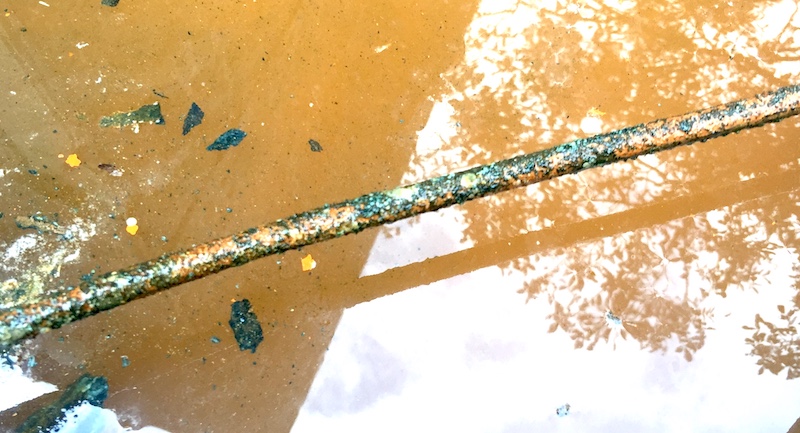 OK, here is a shot of the anode. I went and pulled it before the normal length of time to show what I am talking about. Had this been running for the normal 6-8 hours these dark blueish deposits would be much more obvious. Some of the deposits fell off into my drum of electrolyte and are floating in the background. The drum had metal mold release agent residue when I got it, but 99.9% of that was gone before I put it to use. Basically that stuff was just some sort of oil and I don't think it has any effect here. If this is lead from the paint it might be a good indicator that the rust is about gone. I will turn the fender again and run it all day tomorrow. After that I will snap another picture of both the other fender that hasn't had the electrolysis applied and the one now in my tank before rinsing and wire brushing. I am absolutely sold on this rust removal system even if a little lead is involved. Considering all the sinkers I clamped shut over fishing line with my teeth if lead was gonna get me it already would have.
Edited by theropod - 31 Oct 2017 at 4:19pm
|
|
CrestonM
Orange Level
Joined: 08 Sep 2014
Location: Oklahoma
Points: 8479
|
Post Options
Thanks(0)
Quote Reply
Posted: 31 Oct 2017 at 4:37pm |
|
It was my understanding the old equipment paint has lead in it.
Somebody told me once that no new paint can match the durability of lead-based paint; scratch resistance, resistance to fading, and things like that.
While I don't have much experience with it, I know the old faded out lead based paint is really easy to restore the shine on. I rubbed some wax on one of my All-Crops that was all faded out, from sitting outside 67 years, and The parts I waxed look almost brand new now!
I don't know if new paint will be able to do that or not, but I guess we will find out someday.
|
|
Ted J
Orange Level

Joined: 05 Jul 2010
Location: La Crosse, WI
Points: 18967
|
Post Options
Thanks(0)
Quote Reply
Posted: 01 Nov 2017 at 7:23am |
|
I don't know if that is where the bluish tint is coming from, but YES, the old paint had lead in it.
That is another reason why you can't get an exact match on the old paints, no lead in the new paints.
Edited by Ted J - 01 Nov 2017 at 7:24am
|
|
"Allis-Express"
19?? WC / 1941 C / 1952 CA / 1956 WD45 / 1957 WD45 / 1958 D-17
|
|
theropod
Orange Level
Joined: 28 Sep 2017
Location: Arkansas USA
Points: 217
|
Post Options
Thanks(0)
Quote Reply
Posted: 01 Nov 2017 at 3:09pm |
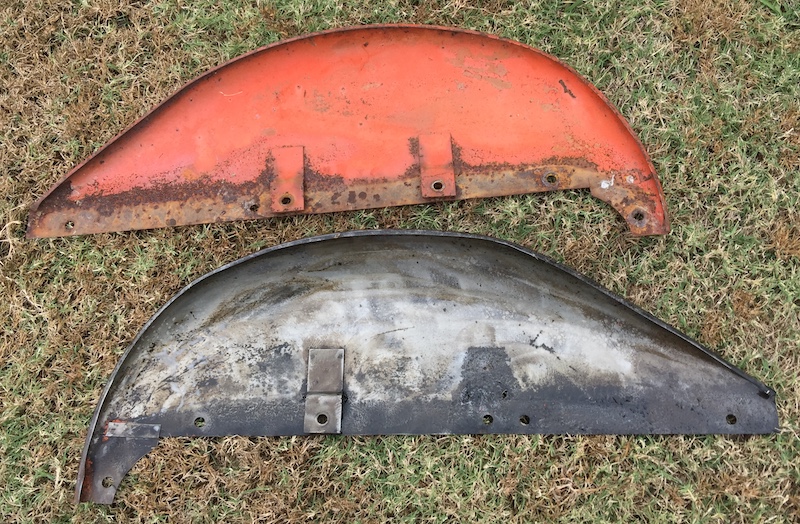
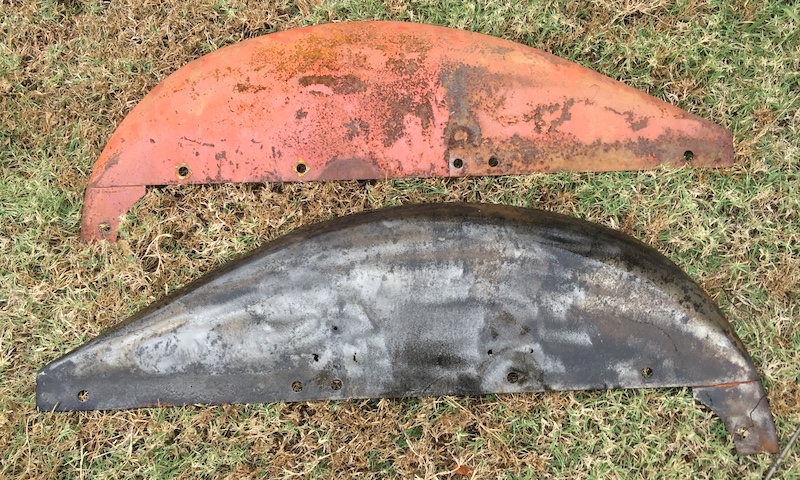 OK, here is what the fenders from my old B look like both before and after electrolysis. I couldn't help myself and wire brushed off the residue from the treated fender. There is no rust at all left on the fender that has been treated. That residue just fell off with the slightest contact with the wire brush. I took it in the shower and scrubbed it with hot water and strong soap, and with a little sanding it will be ready for primer. These shots proceed that scrubbing. All that was left was a black residue and a few bubbled up paint patches which just washed away with the hot water. After that scrubbing it almost looks like new steel. Note that there are a couple spots that have rusted completely through, and that one of the mounting brackets spot welds gave up (bracket fell off before treatment and not on the bottom of the 55 gallon drum). This is just so much easier than any other method I have tried for rust removal. I think it is less messy than dry blasting.
|
|
Put the bunny back in the box!
1938 B, 1977 Yanmar YM2200
No private messages:
use email:
theropod AT yahoo DOT com
|
|
CrestonM
Orange Level
Joined: 08 Sep 2014
Location: Oklahoma
Points: 8479
|
Post Options
Thanks(1)
Quote Reply
Posted: 01 Nov 2017 at 4:39pm |
Wow! So the electrolysis ate all the paint and rust right off? If so, I will definitely have to try that. I've always dreaded paint prep work, but if it's that easy, maybe it won't be so bad!
|
|
theropod
Orange Level
Joined: 28 Sep 2017
Location: Arkansas USA
Points: 217
|
Post Options
Thanks(0)
Quote Reply
Posted: 01 Nov 2017 at 6:16pm |
CrestonM wrote:
Wow! So the electrolysis ate all the paint and rust right off? If so, I will definitely have to try that. I've always dreaded paint prep work, but if it's that easy, maybe it won't be so bad! |
Yep it turned the old paint into a slimey goo, or knocked it loose in the tank, and flat out dissolved the rust. It seemed to turn the rust into some sort of black residue that comes right off with little effort. I didn’t spend 5 minutes with the wire brush on the angle grinder and a hand held brush would have worked just as well. Everything that was left just fell off with one swift pass of the wire brush. Scotchbrite and a bucket of soapy water would have done the same thing. If I had a more powerful battery charger I am sure the process would have been quicker, but I have a LOT more time than money. As it was this fender spent about 3 days in the barrel and my charger never went above 4 amps according to the little analog meter. My electrolyte might be a touch on the strong side as I guesstimated the ratio. I did pull the sacrifical anode every 6-8 hours and take it back to bright steel with the same angle grinder wire brush. I would skim off the foamy junk that forms with each anode cleaning, but I don’t think that was really a factor. When I would retrun the anode to the tank and start back up the amp meter would go up to around 4 amps and slowly drop as gunk grew on it again. My old charger isn’t one of those “smart” units, and I have heard they don’t work work well without a battery in line. All I know is this is flat out magic! All sorts of rusty junk is going to get this treatment!!
|
|
Put the bunny back in the box!
1938 B, 1977 Yanmar YM2200
No private messages:
use email:
theropod AT yahoo DOT com
|
|
rustydollar
Orange Level
Joined: 07 Aug 2017
Location: Manitoba
Points: 456
|
Post Options
Thanks(0)
Quote Reply
Posted: 01 Nov 2017 at 7:26pm |
Ted J wrote:
I don't know if that is where the bluish tint is coming from, but YES, the old paint had lead in it.
That is another reason why you can't get an exact match on the old paints, no lead in the new paints.
|
More probably cadmium which is no longer used because its a carcinogen. Metal: Silver-white, blue-tinged lustrous, odorless solid.
https://pubchem.ncbi.nlm.nih.gov/compound/cadmium#section=Color
|
|