![]() |
This site is not affiliated with AGCO Inc., Duluth GA., Allis-Chalmers Co., Milwaukee, WI., or any surviving or related corporate entity. All trademarks remain the property of their respective owners. All information presented herein should be considered the result of an un-moderated public forum with no responsibility for its accuracy or usability assumed by the users and sponsors of this site or any corporate entity. | |||||
| The Forum | Parts and Services | Unofficial Allis Store | Tractor Shows | Serial Numbers | History | |
Switching generator to alternator |
Post Reply
|
| Author | |
keithpearson
Bronze Level
Joined: 20 Apr 2014 Location: wis Points: 108 |
Post Options
Thanks(0)
Quote Reply
Topic: Switching generator to alternatorPosted: 20 Sep 2026 at 4:14pm |
|
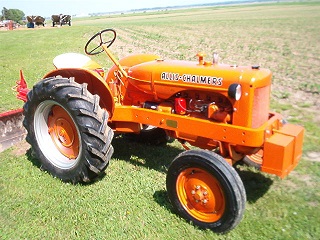
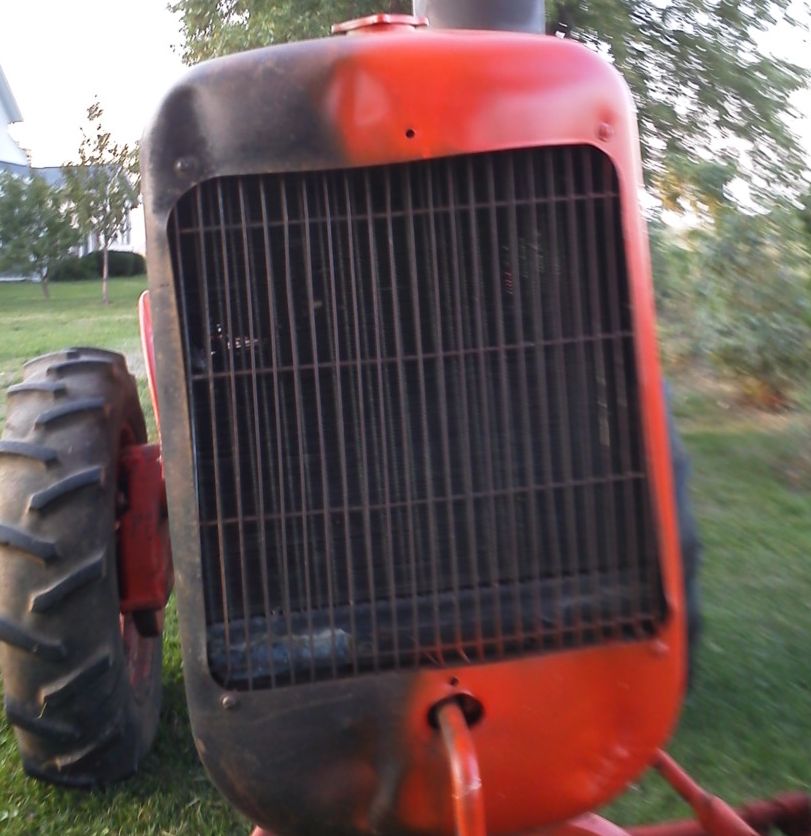
I'm in the process of switching my D17 series 4 over to an alternator. The alternator that I have is too big to fit inside the cowling. What alternator do you guys recommend to use to fit inside cowling without having to cut it up to get the alternator to fit
|
|
|
WD45,160 6040,D14,D15,D17,D19,D21,and still looking for more
|
|
![]() |
|
| Sponsored Links | |
![]() |
|
steve(ill)
Orange Level Access
Joined: 11 Sep 2009 Location: illinois Points: 93125 |
Post Options
Thanks(0)
Quote Reply
Posted: 20 Sep 2026 at 5:01pm |
|
The old standard is the DELCO 10SI with internal regulator..
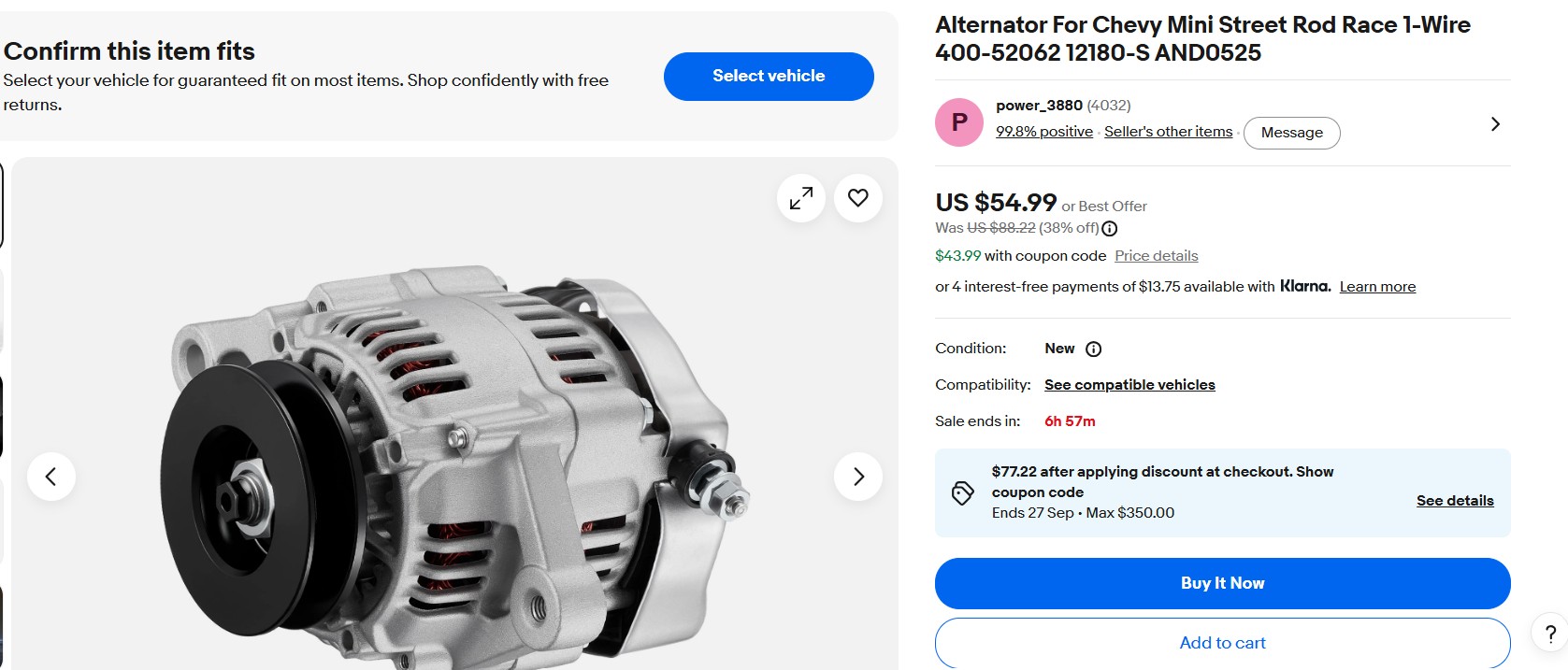
If you want one about 2/3 that size, you get the DENSO type, or "chevy mini".... prices range from $75. up to about $150. .. many of these are ONE WIRE, meaning there is no spade connector plug needed, just power cable to the battery ............ this is on ebay... everyone sells these. ![]() Edited by steve(ill) - 20 Sep 2026 at 7:27pm |
|
|
Like them all, but love the "B"s.
|
|
![]() |
|
steve(ill)
Orange Level Access
Joined: 11 Sep 2009 Location: illinois Points: 93125 |
Post Options
Thanks(0)
Quote Reply
Posted: 20 Sep 2026 at 7:23pm |
|
25 years ago i started upgrading a few tractors with an alternator... At that time, DELCO 10SI was the standard... but was being replaced with the NEW CS130 which was smaller.. I have several of those in service... Thats another option..... these normally have a spade connector fittin on the side.. Two terminals are use, on gets 12v, the other gets a 12v SIGNAL to start the charge, similar to wiring up the older 10 SI.
------------ The Delco Remy CS130 is a compact, high-output internal-regulator alternator used heavily by General Motors from 1986 through the mid-1990s
Edited by steve(ill) - 20 Sep 2026 at 7:26pm |
|
|
Like them all, but love the "B"s.
|
|
![]() |
|
DrAllis
Orange Level Access
Joined: 12 Sep 2009 Points: 23502 |
Post Options
Thanks(0)
Quote Reply
Posted: 20 Sep 2026 at 9:48pm |
|
Whenever I did a Delco on a D-17 tractor, I always left the fan off of the alternator to avoid cutting sheet metal. I always figured the radiator fan blast was adequate for alternator cooling and it apparently was, as I never had a failure and many of those conversions operated electric corn planter fans. If there was a lack of cooling I would have known about it decades ago.
|
|
![]() |
|
Straanger
Bronze Level
Joined: 10 Dec 2019 Location: Michigan Points: 70 |
Post Options
Thanks(0)
Quote Reply
Posted: Yesterday at 12:32am |
|
There are also “alternator in a generator case “ options that have been used for years in the hot rodding community. I have no idea about how reliable they are since I haven’t followed that stuff for many years. But it’s another option to look into that would keep the original look, if you can find the right one.
|
|
![]() |
|
PaulB
Orange Level
Joined: 12 Sep 2009 Location: Rocky Ridge Md Points: 5439 |
Post Options
Thanks(0)
Quote Reply
Posted: Yesterday at 8:58am |
|
One thing to know is that alternators have a miniscule current draw when not running. For anything that get seldom used. It's best to remove the ground cable or have a master disconnect.
|
|
|
If it was fun to pull in LOW gear, I could have a John Deere.
Real pullers don't have speed limits. If you can't make it GO... make it SHINY |
|
![]() |
|
SteveM C/IL
Orange Level Access
Joined: 12 Sep 2009 Location: Shelbyville IL Points: 9202 |
Post Options
Thanks(0)
Quote Reply
Posted: Yesterday at 9:13am |
|
Good point Paul. Over time they can drain your battery.
|
|
![]() |
|
steve(ill)
Orange Level Access
Joined: 11 Sep 2009 Location: illinois Points: 93125 |
Post Options
Thanks(0)
Quote Reply
Posted: Yesterday at 9:19am |
|
a GOOD alternator will have no parasitic draw while setting... If you do have a draw, then one of you diodes is defective in the regulator.... Not real common, but yes, it does happen.
Edited by steve(ill) - Yesterday at 9:23am |
|
|
Like them all, but love the "B"s.
|
|
![]() |
|
DrAllis
Orange Level Access
Joined: 12 Sep 2009 Points: 23502 |
Post Options
Thanks(0)
Quote Reply
Posted: Yesterday at 9:30am |
|
My experiences 30 years ago with the early versions of the 10SI Delco "one-wire" alternators left me pretty sour on parasitic draw. When you're trying to convert an old tractor over as quickly and easily as possible to 12V with alternator, you would naturally choose the one-wire alternator, only then to have trouble with the battery being dead every time the tractor sat for maybe a month not being used.
|
|
![]() |
|
TedN
Silver Level
Joined: 30 Apr 2025 Location: Central WA Points: 360 |
Post Options
Thanks(0)
Quote Reply
Posted: Yesterday at 11:50am |
|
One other issue with the older one wire alternators that I have run into is some tractors don't spin them fast enough to start charging. When we needed an alternator for my brother's forklift I ordered several different mini alternators from Amazon, I think they were all one wire and if I remember right I found three different frames. I ordered one of each as they didn't cost a lot back then, figuring we would probably eventually find a use for them. My D14 has a Ford style alternator on it with external regulator. It was on the tractor when I bought it and it works, so I haven't looked at how it is wired. If you don't mind doing some wiring you can use the Delco 10dn with an external regulator and not have issues with battery drain or worrying about whether the engine will spin fast enough to trigger it.
Ted |
|
|
190XTD seriesIII, 190XTD seriesI, maroon belly 7000, 7030, 7045, D14, 190XTD series??? project(or maybe parts)
|
|
![]() |
|
keithpearson
Bronze Level
Joined: 20 Apr 2014 Location: wis Points: 108 |
Post Options
Thanks(0)
Quote Reply
Posted: Yesterday at 11:55am |
|
Thank you everyone for all your input it's greatly appreciated!!
|
|
|
WD45,160 6040,D14,D15,D17,D19,D21,and still looking for more
|
|
![]() |
|
Stan R
Orange Level Access
Joined: 03 Dec 2009 Location: MA Points: 1005 |
Post Options
Thanks(0)
Quote Reply
Posted: Yesterday at 12:57pm |
|
I converted our D17 IV some years back. Not the one wire type alternator. One I have charges all the time (all engine rpm's).
I tweaked the alternator bracket and "bracket that tightens the belt". Which was essentially changing the bracket angle a bit by cutting it and rewelding it. I used the same belt, NO sheet metal was cut and it's still tucked under the hood. If interested in pics, let me know. I'll be at the farm tomorrow. |
|
![]() |
|
Les Kerf
Orange Level
Joined: 08 May 2020 Location: Idaho Points: 1893 |
Post Options
Thanks(0)
Quote Reply
Posted: 23 hours 29 minutes ago at 4:06pm |
Ummm... well, yes, kinda sorta ![]() Even the very best diodes will have measurable leakage current but it may be only a few microamps, and most folks don't play with meters that can measure that small. A good alternator will allow leakage current in the low single digits of milliamps (less than 10 milliamps). Anything over 100 milliamps is cause for concern IMHO. When I was in the Biomed business repairing medical equipment we had to test for leakage current; an extension cord plugged into a wall outlet will have a few microamps of current flowing through the insulation of the cord itself. The ground conductor was only allowed to a maximum of ~300 millohms resistance as well.
|
|
![]() |
|
Les Kerf
Orange Level
Joined: 08 May 2020 Location: Idaho Points: 1893 |
Post Options
Thanks(0)
Quote Reply
Posted: 23 hours 21 minutes ago at 4:14pm |
Yup. My Model C wouldn't rev fast enough to excite the one-wire alternator that I installed on it some years ago, I had to force the governor rod at the carburetor to open the throttle manually. I did not like doing this on a cold engine so I replaced it with a three-wire unit. The one-wire unit now resides on my Son-in-law's HD5G, the Screamin' Jimmy has no problem spinning it fast enough to charge the battery.
|
|
![]() |
|
DaveKamp
Orange Level Access
Joined: 12 Apr 2010 Location: LeClaire, Ia Points: 6163 |
Post Options
Thanks(0)
Quote Reply
Posted: 16 hours 51 minutes ago at 10:44pm |
|
Most of the charging issues people have with 'one-wire' setups, is simply insufficient self-excitation, combined with the loss of residual magnetism. When an externally-regulated alternator starts, the regulator applies battery current to the field, which is revolving inside the stator, which then generates AC, which is sent (usually in three phases) to the rectifier bridge (six diodes in one convenient package), where it is turned into DC... and that DC is 'sampled' by the regulator to determine wether voltage is too low (where it then adds more field current) or too high (where it reduces field current) to get the proper output voltage. Of course, once the alternator is charging, the regulator can obtain field current from the alternator's output... so the battery, as an excitation source, is only needed for a second or so. A 'one wire' setup doesn't use the battery as it's source of excitation... it relies on a simple little piece of physics- Magnetism... specifically, the fact that iron and steel pieces inside the alternator, once subjected to a strong magnetic field, will have a tendancy to retain that magnetic field for a good while. Now, most of you have a magnetic screwdriver in your toolbox... and when you need to start a phillips screw from a long ways away, that's a really handy thing. What about when you got a screwdriver, and you WANT it to be magnetic? Well, you snap a magnet on it for a minute or two, then you drag the magnet down the shank, past the end of the bit, and off... and tah-dahh... you have a magnetic screwdriver. Another way to make that happen, is to wrap a dozen turns of hookup wire around the screwdriver shank, and connect it to a battery... as long as the battery is connected, that screwdriver will be an electromagnet. Disconnect the battery, and MOST of the magnetisim will vanish, but SOME will stick around. It's called 'residual'... not because it is residue... it's because it's RESIDENT. It will eventually fade, but you'll have stuff stickin' to it for a fair amount of time. When an alternator rotor is energized, it's an electromagnet. Turn off that power, and MOST of the field will drop off, but a LITTLE BIT will stick around. Next time you spin that alternator, without adding external battery power, it might not generate gobs of power, but it will probably generate JUST ENOUGH to bring up excitation current all on-it's-own... and THIS is what the 1-wire alternator depends on. Now, if that residual magnetism is a little weak, spinning the alternator FASTER will cause it's slight magnetism to generate more output, and it'll kick on. Residual magnetism doesn't stick around forever... it fades, and eventually, won't be strong enough to self-start a one-wire. Applying a little external DC to the field will bootstrap it back into operation. Running the engine more often... will help maintain a strong residual field. Making the alternator work against a really high load... helps build and maintain a strong residual field. Connecting the windings of the alternator in WYE configuration (rather than Delta) will result in higher output VOLTAGE (albeit at lower current), and thus, cause the alternator to self-excite 'easier' (at a lower speed). A prevailing thought by many, is that an alternator of higher CURRENT RATING is more desireable than a lower current rating... but frequently, the higher current rating is gotten by using a lower-voltage winding count... and as a result, these alternators require much higher rotor speed to output sufficient voltage to maintain a battery charge. Unless the engine is spinning the alternator in that range, it really isn't charging... so while higher output looks good on paper, the a lower output alternator is charging the battery basically constantly, while the high-output is only 'in working range' part of the time. When a guy has a tractor that he doesn't start often, and it isn't charging while he runs it... means that the battery-charge-economics is simply never making it out of the red. Start it up, and run it at a higher RPM, mebbie it'll start charging... The alternators I use on my retrofitted equipment are frequently one-wire, and when I get them, I have my local shop set them up for me for extremely low starting-speed. He wires the outputs in Y, and uses finer wire, with more turns in the windings so the output voltage comes up higher, faster... they all self-excite BELOW idle speed, so when they're running at idle, I'm getting at LEAST 10A of charging. Bring it up off idle, it might jump to just 25A or so, but it's solid 25 all the time, not dropping out when I idle it down. As an aside note, if you ever wind up with a generator... either engine- or PTO-driven, and it won't generate output, it is highly possible that the problem is simply no excitation... due to the residual magnetism being depleted. If this is the case, it can easily be solved by connecting the generator to a resistive load (a milkhouse heater, or heat lamp works great)... start the engine, then smack a big magnet onto the exterior of the generator framework. This will simulate a 'residual' field. Now bump the throttle on the generator engine for a few moments, and once you release it, you'll hear the engine 'grunt' while the governor brings on fuel to match the new load. Now that it's running stable, leave it run, generating a chunk of power for an hour or two... it'll rebuild it's residual magnetism, so no magnet will be needed next time.

|
|
|
Ten Amendments, Ten Commandments, and one Golden Rule solve most every problem. Citrus hand-cleaner with Pumice does the rest.
|
|
![]() |
|
jvin248
Orange Level
Joined: 17 Jan 2022 Location: Detroit Points: 510 |
Post Options
Thanks(0)
Quote Reply
Posted: 2 hours 59 minutes ago at 12:36pm |
|
.
I used that Denso alternator on my '55 Ferguson TO35 when I converted it to 12v-neg ground. The original generator on it had to be reved to get it charging. Made the conversion when rewiring. Nice to eliminate connections and extra devices with regulator block is gone, resistor block is gone. It's been quite reliable since. My AC WD is still factory 6v-positive ground and when it gives me troubles or I need a new battery it's getting converted. . |
|
![]() |
|
Post Reply
|
|
|
Tweet
|
| Forum Jump | Forum Permissions ![]() You cannot post new topics in this forum You cannot reply to topics in this forum You cannot delete your posts in this forum You cannot edit your posts in this forum You cannot create polls in this forum You cannot vote in polls in this forum |